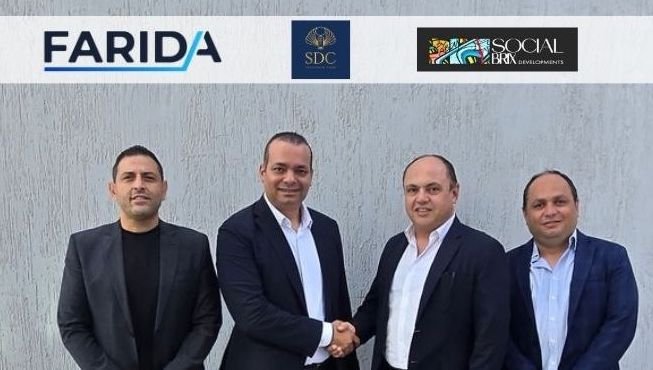
Social Brix, Sakr Investment Fund, FARIDA Partner to Launch New Real Estate Investment Model in Egypt
Social Brix Developments has partnered with Sakr Investment Fund and FARIDA – fractional real estate ownership – to launch a new real estate investment model in Egypt, combining real estate development, institutional investment, structured financing, and technology.
The partnership aims to build a portfolio of projects and investment opportunities worth more than EGP 30bn during 2026 and 2027 across key investment areas, including New Cairo, 6th of October city, New Sphinx city, which serves the area around Sphinx International Airport, as well as North Coast and Red Sea.
Social Brix will serve as real estate development arm for Sakr Investment Fund and FARIDA, overseeing the full project cycle, from asset selection, opportunity assessment and feasibility studies through development, financing and execution, followed by marketing, sales and asset management. The company will also focus on creating sustainable investment and operational value across its projects.
The model brings together three complementary roles. Social Brix will leverage its expertise in development, execution, project management and marketing, while Sakr Investment Fund will provide the investment and structuring framework.
Meanwhile, FARIDA will provide a digital platform for accessing investment opportunities and offer full and fractional ownership products, depending on the nature of each project and its approved legal and regulatory structure.
The partnership comes as Egypt’s real estate market undergoes changes in its operating, financing and regulatory mechanisms, alongside government efforts to develop the regulatory framework governing the sector and strengthen the protection of the rights of stakeholders across real estate ecosystem.
In September 2026, the government continued consultations on a draft law to regulate real estate market, stressing the importance of establishing a legal framework that encourages real estate investment while protecting the rights of the state, developers, buyers and other stakeholders. The framework also aims to address stalled projects and improve market efficiency.
The recent period has also seen developments in the regulation of real estate investment instruments. The Financial Regulatory Authority (FRA) has established a framework for digital platforms facilitating investment in real estate investment fund units, covering investor disclosures, secure payment and collection channels, and access to feasibility studies and risk information. The framework is intended to support a more regulated and transparent investment environment.
The alliance partners believe that the current market environment is creating scope for new investment models that redefine the relationship between developers, investors, and real estate assets.
Ahmed Sakr: New Model to Enhance Investor Protection
Ahmed Sakr, Chairman of Sakr Investment Fund and FARIDA, and a Board Member of Social Brix, stated that the partnership aims to offer a different experience for real estate investors, based on a clearly defined asset, a structured investment framework, and clearer mechanisms for governance and monitoring.
Sakr said, “Egypt’s real estate market is entering a new phase. Investors are no longer looking only for a good opportunity, but also for a system that protects their investment and provides greater transparency on the asset they are investing in, how their funds are being used, and phases of project execution.”
He added that escrow accounts and cooperation with banking institutions are key components of the model, helping regulate financial flows and link the use of project funds to actual development phases in accordance with the approved legal and financial structure of each project.
Sakr added that the model aims to protect investors’ rights, ensure funds are used for their intended purposes, and secure the financing required to complete projects efficiently and on schedule.
He noted that the FRA’s regulatory framework for real estate investment funds is an important element in developing institutional real estate investment, particularly amid the current trend toward expanding the use of digital and regulated investment tools in the sector.
He added that FARIDA brings the digital component to the model by providing a channel for accessing selected and structured real estate opportunities and investment products.
The platform aims to offer both full and fractional real estate ownership opportunities, expanding the pool of investors able to access real estate investments. FARIDA will serve as the digital link between the assets and projects being developed and structured on one side, and investors seeking investment opportunities on the other.
Ahmed Fouad: Moving from Unit Sales to Asset Creation and Management
Ahmed Fouad, Chairman of Social Brix Developments, said that the partnership represents a shift from a model primarily focused on selling units toward a more comprehensive model centered on creating, managing, and investing in real estate assets.
“We no longer view Social Brix as simply a developer offering units for sale. Rather, we see it as an integrated platform that starts with assessing opportunities and selecting assets, followed by development, execution, project management, and marketing, ultimately creating value and generating returns from the asset,” he added.
The model allows investors to invest in full or fractional ownership interests in commercial, administrative, or hotel properties, depending on the legal and investment structure of each project. It also provides a clear plan for operating the asset and generating revenues, supporting potential rental or investment returns based on the nature and actual performance of each project.
The group is preparing to launch a number of projects in the coming period that will not rely solely on selling real estate units. Instead, the projects will be comprehensively prepared and planned before being offered to investors, based on an assessment of the asset’s nature, selection of the appropriate product, and development of operating and management plans. The group also plans to work with specialized operators and brands for commercial, administrative, and hospitality projects, with the aim of creating operational and investment value for each asset from the outset.
The targeted products will include profit-generating hospitality, administrative, and commercial projects, as well as other investment opportunities developed by Social Brix or through partnerships with other developers and project owners.
The parties involved are studying a number of existing and under-construction projects, in addition to new opportunities selected based on specific technical, commercial, financial, and investment criteria. Details of projects and investment products will be announced successively in the coming period.
Fouad disclosed that technical and financial monitoring of projects will be a key part of the model, involving one of Egypt’s largest engineering consultancy firms to oversee all projects, alongside one of the country’s largest financial advisory firms and cooperation with a major Egyptian bank. This structure will allow progress on the ground to be monitored and project-related financial flows to be reviewed.
The model is not intended only for individual investors, but also provides opportunities for investment portfolios and institutions seeking to invest in Egypt’s real estate market. These opportunities will be structured within clear investment frameworks, with mechanisms for governance and transparency, monitoring of fund flows, and project execution, in accordance with legal and regulatory structure applicable to each opportunity.
Mohamed Hamza, Board Member of Social Brix and the Arab African Company, said that the current developments in Egypt’s real estate market, along with the government’s direction and its new vision for the housing and urban development sector, highlight the need to improve industry practices in a way that creates greater balance between the interests of developers and investors.
“Egypt’s real estate market is entering a new phase. The government is working to develop market mechanisms and establish more structured frameworks to protect the rights of different stakeholders. This is in line with the current direction of the Ministry of Housing, led by Eng. Randa El-Minshawy, which focuses on monitoring, stronger oversight and execution discipline, improving execution efficiency, and maximizing the value and effectiveness of projects and investments,” he added.
Hamza explained that the new vision is not solely about increasing volume of real estate investment, but also about building a more structured and efficient market capable of attracting capital.
He noted that the sector needs solutions that serve both sides of the equation: developers seeking effective financing mechanisms and investors looking for viable investment opportunities with greater levels of protection and transparency.
Social Brix’s role also extends to cooperation with real estate developers, landowners, and project owners. Developers with existing or under-construction projects, or new development opportunities, can enter into joint development agreements with Social Brix to benefit from its integrated development, investment, and marketing capabilities, as well as access to investors. This can help provide financing sources for projects and support their investment and commercial objectives.
“We believe the model being developed through this system represents a solution that can serve both developers and investors. Developers gain a development and investment arm to support the development of their projects, while investors gain access to real assets and projects through a more structured and transparent investment framework,” Hamza concluded
Share this content:







إرسال التعليق